The Street Is Full: What Working in Crowded UK Underground Corridors Is Teaching Us About Cable Installation
Between legacy electricity, gas, water, telecoms and a wave of new fibre and EV infrastructure, the margin for error in the ground beneath UK streets is shrinking. The discipline that fills that gap has a name — and a guidance document behind it.
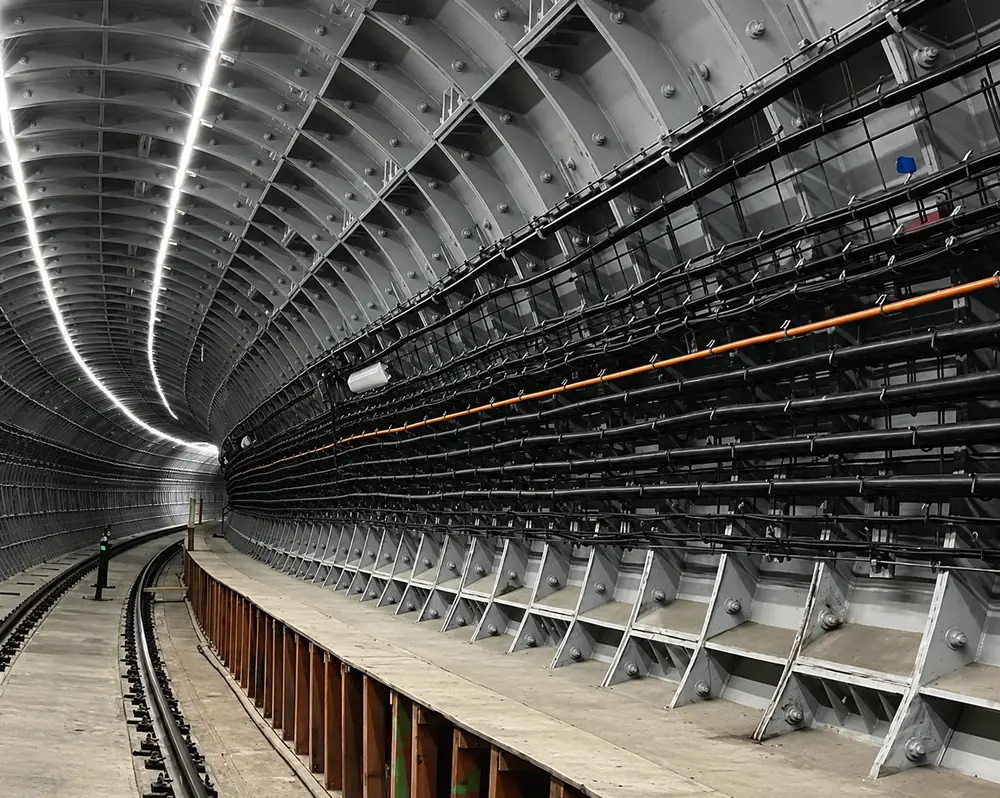
Every time a UK street gets opened for new cable or pipe work, the same uncomfortable truth resurfaces: the ground is full. Decades of incremental electricity, gas, water and telecommunications infrastructure, much of it installed long before modern recording standards existed, sit layered beneath the surface in configurations that are often only partially documented and sometimes not documented at all.
Into that already-congested environment, the current wave of infrastructure investment — full-fibre broadband rollout, EV charging supply cables, grid reinforcement work to support data centre and electrification demand — is adding new services at a pace the existing underground corridor was never designed to absorb gracefully.
The guidance that governs safe digging
The principal reference for working safely around underground services in the UK is HSE's HSG47, "Avoiding Danger from Underground Services." Now in its third edition, it sets out three core elements of a safe system of work: planning the job properly before any ground is broken, locating and identifying buried services using both documented records and physical detection equipment, and carrying out the excavation itself using methods appropriate to what's been found.
It's worth being precise about what HSG47 is and isn't. It is not, in itself, legislation — it carries no automatic legal force the way a statutory instrument does. What it is, is the document the Health and Safety Executive uses as the benchmark for assessing whether an organisation has met its broader legal obligations under the Health and Safety at Work Act 1974 and the Construction (Design and Management) Regulations 2015. If a utility strike occurs and HSE investigates, one of the first things assessed is whether the principles in HSG47 were followed.
"On modern schemes, the cable pull itself is only half the job. The other half is proving — with records, photos, depths and coordinates — that you did exactly what you said you would, in exactly the place you said you'd do it."
Why planning has become the hardest part
HSG47's first principle — planning the work — sounds straightforward until you try to do it properly on a genuinely congested urban route. Before any ground is broken, the organisation responsible for the work needs to obtain current plans from every relevant asset owner: electricity, gas, water, telecoms, and any other services that might be present. Relying on a single source of records, or using out-of-date plans, is explicitly identified as inadequate practice.
In practice, assembling a genuinely complete picture means contacting multiple asset owners, reconciling plans that may use different conventions, scales and levels of detail, and accepting that even comprehensive documentation will sometimes be wrong or incomplete — because not every historic installation was recorded to current standards, and some records simply haven't survived intact.
This is why HSG47 is explicit that plans alone are never sufficient. Physical detection using cable and pipe locating equipment — commonly a CAT (Cable Avoidance Tool) and Genny combination — is required to verify what the documentation suggests, using both passive detection methods and active signal application. The guidance is clear that passive detection alone, without active Genny-based tracing, does not meet the expected standard. And critically, HSG47 requires that anyone operating this detection equipment is genuinely competent to do so — able not just to operate the device, but to correctly interpret what it's reporting and make safe decisions based on that interpretation.
The parallel discipline: recording what you install
Locating existing services is one half of the underground information problem. The other half — recording, accurately and completely, what you yourself install — is the half that determines whether the next person to open that same stretch of ground inherits a clear picture or another layer of ambiguity.
This is governed by a combination of DNO-specific installation and records standards (such as UK Power Networks' G81 framework for LV underground cable networks) and the government's Code of Practice for Recording of Underground Apparatus in Streets. Together, these set expectations for the depth, positional accuracy, and format of records that should be produced and maintained whenever new underground apparatus is installed.
The practical effect of these two parallel disciplines — locating what's already there, and recording what you add — is that underground works on any non-trivial UK site now genuinely constitute a distinct information management discipline, not simply a physical digging and laying exercise bolted onto a project programme.
Why the cable pull is only half the job
For contractors and engineers used to thinking about cable installation primarily in mechanical and electrical terms — tension, friction, sidewall pressure, route geometry — the documentation dimension can feel like an administrative add-on rather than a core part of the technical work. That framing is increasingly out of step with how the work is actually being assessed, both by regulators and by clients.
A cable pull that goes in cleanly, within the manufacturer's tension limits, on schedule, but produces no usable as-built record of its actual position and depth, has only delivered half of what a modern client genuinely needs. The next contractor who needs to work near that route — whether next year or in fifteen years — inherits exactly the same documentation gap that made this project's own planning phase more difficult than it needed to be.
- Photographic records at key stages — particularly before backfilling, when the installed apparatus and its relationship to surrounding services is still visible — are far more valuable as evidence than a written description alone.
- Positional accuracy genuinely matters. A record that places a cable "approximately" where it actually sits is barely more useful than no record at all, once enough time has passed that nobody remembers the specific job.
- Depth recording needs to reflect as-installed reality, not the designed or specified depth, because ground conditions and obstructions routinely force deviations from the original design during installation.
- Coordinate-based records, ideally in a format compatible with modern GIS and asset management systems, are increasingly expected rather than optional — both by regulators pushing toward more accurate national underground service records, and by clients who manage their own infrastructure digitally.
HSE, HSG47 "Avoiding Danger from Underground Services" (3rd edition); UK Government Code of Practice for Recording of Underground Apparatus in Streets; UK Power Networks G81 Installation and Records framework.
The competitive advantage hiding in plain sight
There's a quiet opportunity in all of this for contractors willing to take the documentation discipline as seriously as the physical installation work. As underground corridors get more congested and the consequences of poor records become more visible — through utility strikes, failed surveys, and disputed liability when something goes wrong — clients and principal contractors increasingly value, and increasingly ask about, the quality of as-built documentation a contractor can reliably produce.
Treating underground space as the constrained, valuable resource it actually is — rather than a convenient void to be filled and then forgotten about — is not a regulatory burden. It's increasingly a genuine point of differentiation between contractors who get repeat work on complex sites and those who don't.
Talk to us
Underground cable work on a congested or poorly documented route?
Underground cable installation benefits from proper planning and detection work before excavation begins, and accurate as-built recording once it's complete. We treat both as core parts of the installation, not administrative add-ons.