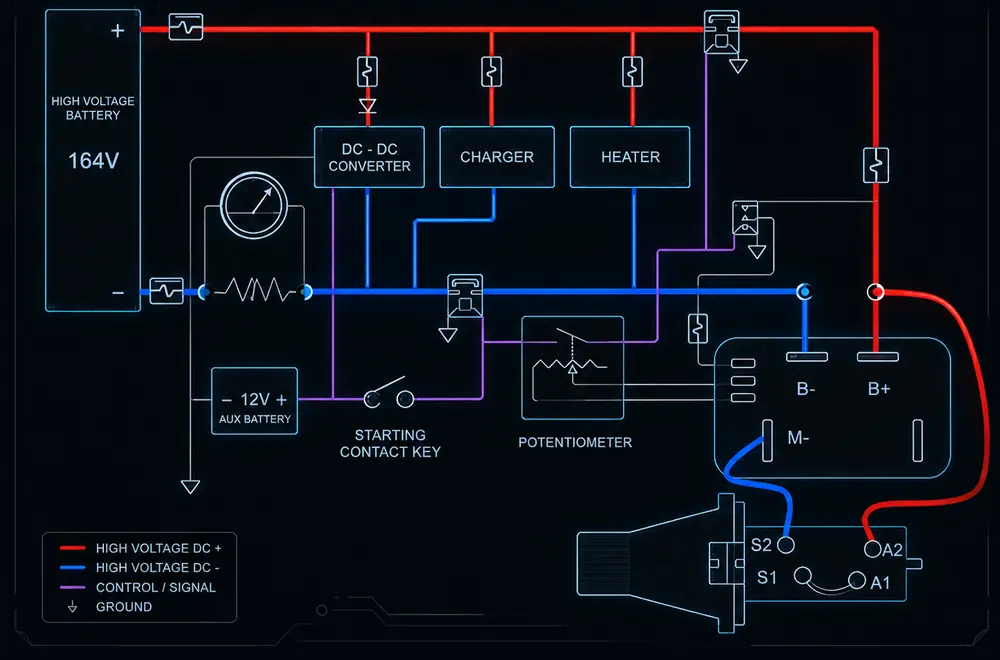
The Battery Storage Chapter Nobody's Talking About Yet
While most of the EV charging conversation still references wiring rules from 2022, the genuinely significant update to BS 7671 just published — and it isn't about EV charging at all.
There's a specific kind of confusion that's been circulating across the electrical industry over the past several months, and it's worth untangling properly because it has real consequences for anyone specifying or designing electrical installations right now. The confusion concerns which amendment to BS 7671 actually governs what.
EV charging requirements are governed by Section 722, introduced in Amendment 1:2020 and substantially expanded by Amendment 2:2022 — mandatory since 27 March 2023. The amendment discussed in this article, Amendment 4:2026, is a separate and more recent update. It is not primarily about EV charging. Its headline content concerns battery storage, Power over Ethernet, and medical locations.
What actually arrived on 15 April 2026
The Institution of Engineering and Technology and BSI jointly published Amendment 4 (2026) to BS 7671:2018 on 15 April 2026, following content sign-off announced on 15 January 2026. The formal designation is BS 7671:2018+A4:2026 — referred to within the industry as "the Orange Book" — consolidating the previous amendments A1:2020, A2:2022, and A3:2024 into a single complete publication alongside the new content.
The headline addition is a genuinely new chapter on Stationary Secondary Batteries, covering the electrical storage and supply requirements for battery installations. This is the first time the Wiring Regulations have addressed battery storage at this scale and specificity, reflecting how rapidly battery energy storage systems have moved from a niche application into mainstream commercial and industrial infrastructure.
Alongside the battery chapter, Amendment 4 introduces a new section on functional earthing and functional equipotential bonding specifically for ICT equipment and systems — directly relevant to data centre and smart building infrastructure. There's also a dedicated treatment of Power over Ethernet circuits, recognising that PoE now routinely delivers power levels the original wiring regulations never anticipated, and a major revision of Section 710 covering medical locations.
The transition timeline that matters for live projects
Amendment 4 can be implemented immediately from its 15 April 2026 publication date. The previous version — BS 7671:2018+A2:2022+A3:2024 — remains valid until its formal withdrawal six months later, on 15 October 2026. During this transition window, installations can be designed and certified to either version.
After 15 October 2026, the previous edition is no longer the recognised standard. Competent person schemes including NICEIC have been explicit that businesses will need to demonstrate access to and competence with Amendment 4 as a continuing condition of scheme registration from that date. Continuing to certify work against the withdrawn edition after that point creates genuine professional and legal exposure.
"For anyone working on commercial battery storage, data centre UPS systems, or PoE-heavy smart building infrastructure, this is the amendment that actually matters to your specification work over the next twelve months."
Why this matters specifically for data centre and critical infrastructure work
The three headline areas of Amendment 4 — battery storage, ICT functional earthing, and PoE — map almost precisely onto the infrastructure categories driving the current wave of UK data centre and grid investment. Battery energy storage systems are increasingly integral to data centre resilience strategy, both as UPS infrastructure and as grid-balancing assets. ICT functional earthing requirements speak directly to the dense electronic infrastructure inside any modern data hall.
Anyone scoping work in these categories with a completion date beyond October 2026 should be designing to Amendment 4 from the outset, rather than designing to the outgoing edition and planning to update mid-project. The cost of switching design basis partway through a project is consistently higher than designing correctly from day one.
Practical steps for the transition period
- Audit current pipeline projects against their expected completion date. Any project genuinely likely to complete after 15 October 2026 should be reviewed against Amendment 4 requirements now, not closer to the withdrawal date.
- Prioritise Amendment 4 familiarisation for teams working on battery storage and ICT-heavy projects specifically — these are the areas where the new content is most substantively different from previous editions.
- Review standard method statements, test sheets, and EICR templates for compatibility with the new chapters — particularly the additional data and recording requirements introduced for battery installations and medical locations.
- Confirm competent person scheme requirements directly with your specific scheme provider — NICEIC, NAPIT, or others — since audit and demonstration-of-competence expectations following the October 2026 withdrawal date may vary by scheme.
IET & BSI joint press release, "IET and BSI officially publish Amendment 4 (2026) to BS 7671:2018," 15 April 2026; NICEIC Amendment 4 transition guidance; original content sign-off announcement, 15 January 2026.
The wider point is a reminder of how quickly the regulatory ground can shift beneath an industry that's been focused on a different, earlier amendment for the past few years. Section 722 and EV charging dominated the conversation from 2022 onward for good reason. But staying current means tracking what's actually new now, not what was new three years ago.
Talk to us
Project involving battery storage or ICT scope?
If your project has a completion date beyond October 2026, it's worth confirming your design basis reflects Amendment 4 from the outset.